Sean Lee | Product Design Lead | San Mateo, CA
Task Plan

Task Plan helps scientists schedule and define manual lab tasks, giving operators the clarity they need to execute complex workflows confidently without disrupting live experiments.
I led end-to-end research and design of the experience, bridging the software planning layer with the bioreactor hardware execution interface. The result was a seamless handoff between scientists and operators that supported commercial rollout and helped secure major client deals.
What initially appeared to be a simple scheduling problem revealed a deeper challenge: scientists and operators had fundamentally different mental models of the same workflow.
Discovery:
Where the Workflow Broke Down
Customers were reporting inconsistent experiment quality. Early research revealed that delays in operator-performed manual tasks were a major contributor. I led discovery with scientists and lab operators to map the real-world experiment workflow and identify where breakdowns occurred. This journey work clarified the end-to-end process, surfaced root causes, and helped pinpoint where design could have the greatest impact.


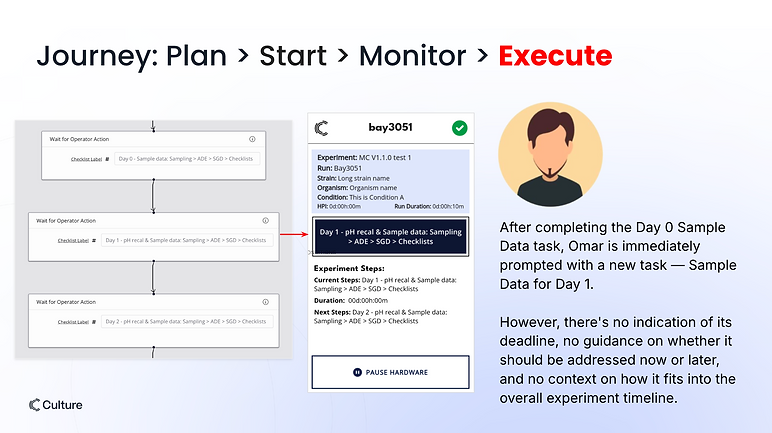

Through discovery, I identified that the issue wasn't the bioprocessing system itself, but a lack of clear, actionable information for operators performing manual tasks. This gap caused delays during critical steps and ultimately affected experiment quality.
This revealed a two-sided design challenge: improving how scientists define and communicate tasks in Task Plan, and how operators receive and execute them in the Bay bioreactor interface. The goal was to close the gap at both ends of the handoff.
Process:
Designing Toward a Solution
After aligning on the root cause and defining the design objective, I moved into structured design exploration. I facilitated cross-functional workshops with product, engineering, scientists, and lab operators to align on the problem and generate solutions through empathy mapping and design sprint exercises. We prioritized ideas through collaborative voting and defined both near-term MVP and longer-term strategy. The MVP focused on enabling scientists to clearly define and hand off detailed manual tasks, increasing operator confidence and execution accuracy.

The empathy mapping exercise helped the team understand how scientists plan experiments versus how operators interpret and execute tasks, revealing gaps in task clarity and timing.

After empathy mapping, we moved into brainstorming, and created an affinity map to identify patterns across the team’s proposals. This helped us quickly converge on a clear direction and prioritize the MVP features needed to support in a fast-paced startup environment.

From brainstorming, we moved into sketching, turning abstract ideas into tangible solutions. Visualizing concepts helped us quickly evaluate what would actually work in practice and align on an MVP focused on closing the gap between scientists and operators.

Given the regulatory and risk-sensitive nature of the product, I compressed each phase of the process from discovery through refinement to ensure we delivered solutions that were fast, safe, and compliant. The process revealed a clear direction: scientists needed a structured way to define manual tasks during planning so operators could receive precise, executable instructions during live experiments.
For a team that had never run a structured design workshop before, the session produced immediate alignment and action plan, helping everyone move quickly from problem understanding to solution direction.
Solution:
Structuring the Handoff
After identifying the root cause and aligning on the design direction, I introduced Task Plan, a feature integrated directly into the experiment planning workflow. It allows scientists to define manual tasks, assign owners, and specify precise time windows tied to experiment events such as inoculation or completion of prior steps. This gave operators a reliable, structured brief before they ever stepped up to the bioreactor.

Experiment Plans:
Scientists use Console, a cloud-based SaaS platform, to plan, monitor, and analyze experiments. When planning an experiment, they first create a script which defines the recipes and instructions for the bioreactor and then enter a Experiment Plans to provide the input parameters for execution.

Task Plan - Default:
Task Plan is integrated as a new step within the planning workflow, making the experience feel natural and cohesive. The interface uses a split layout: the script on the left and tasks on the right. This keeps scientists oriented in the experiment context while defining task details, without losing their place in the workflow. The script view supports the same pan and zoom interactions used during script creation, while the task view lists all manual tasks as cards, ordered sequentially based on the script.

Task Plan - Edit:
Clicking “Edit details” opens a right-side drawer while keeping the workflow visible. The script view automatically centers and highlights the selected step, helping users maintain context while editing.
Scientists can schedule when the task should start, define completion windows, assign an operator, and add detailed instructions.

Task Plan - Edge Cases:
Because bioprocess workflows involve strict timing dependencies and operational constraints, I prioritized designing beyond the happy path. I identified and addressed edge cases such as scheduling conflicts, missing task owners, and invalid timing conditions. By anticipating these scenarios early, the system guides scientists toward valid configurations and helps prevent execution errors during live experiments.

Task Plan - Task Saved:
Once saved, the task card updates with scheduling details and instructions. The interface simplifies the summary view by displaying only the “Start after” timing, while additional details remain accessible when the card is opened.

Closing the Loop: The Operator Experience
Task Plan solved the planning side, but a seamless handoff also depends on what operators see when they arrive at the bioreactor during a live experiment. To complete the loop, I redesigned the bioreactor interface so tasks defined in Task Plan could be clearly received and executed.
.png)
.png)
User Research:
I led rapid usability testing and iteration with 6 external customers and 4 internal users. The prototype received strong scores across most categories, with one clear gap: users wanted the ability to assign owners to tasks, which was not included in the initial design. We incorporated that feedback and iterated on the prototype by adding assignee functionality, using the research insights to deliver a more complete and valuable solution before handing off the final design.
Outcome:
Coordinating the Workflow Gap

In just four weeks from discovery, the team designed and shipped a solution that addressed a coordination gap affecting experiment quality. Scientists gained a structured way to define and communicate manual tasks, while operators gained the clarity they needed to execute with confidence. Reducing delays in manual interventions helped shorten average experiment cycle time by 2 days in targeted workflow and improved overall experiment consistency.
The impact extended beyond usability. The feature played a direct role in closing a major pharmaceutical client who had previously questioned the platform’s reliability in managing manual workflows. Fixing the handoff didn’t just improve the experience, it helped establish the product’s commercial credibility.
I didn’t change the science. I designed the layer that bridged the gap between the people, platforms, and environments for a seamless scientific workflow.
